

(NOTE: I’m diverging a bit from my usual blog topics to share what I’ve actually been working on these days. My life is increasingly oriented toward education—on a small scale—and the home, occasionally peppered with the opportunity to make things by hand.)
I’ve worked with children in different capacities for many years (nannying, teaching, tutoring, parenting), and I find it helpful to draw them into learning activities and experiences by tapping into their special interests. Frankly, that’s how my brain operates, too. I’ve found so many helpful activities online based on very specific interests, that I’ve decided to share mine here, too, so they can be used by others.
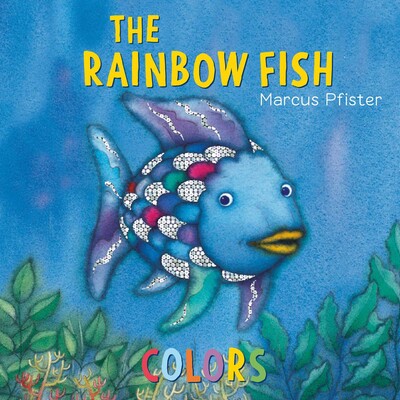
The learner that I currently work with tends to latch onto books, songs, and topics quite readily. One of his most recent loves is the 1992 book The Rainbow Fish by Marcus Pfister. I appreciate some aspects of the book: the encouragement of sharing and friendship, in addition to colorful illustrations and an ocean theme. Others I find odd and problematic—why does the fish have to share parts of his own body in order to make friends? But, I might be taking things a little too literally.
This particular learner has some difficulty finding and arranging things visually (think: puzzles), and is still developing certain fine motor skills. I’m sure there are terms to describe these challenges within the field of special education, but I have a general M.Ed., so I’m being loosey-goosey with language here. He also has a fairly low threshold for frustration if something isn’t 100% within his comfort zone, skill/interest-wise. Often, if I can gently draw him into something that’s a bit of a “stretch” for him, he will find so much joy and satisfaction in it that it becomes his new favorite activity. So, the initial struggle is worth it.
Knowing all this, I created some activities based on The Rainbow Fish book that would combine something he’s interested in with skill areas he might not normally practice independently. His occupational therapist recommended some basic puzzles with 8-12 pieces, so that’s where I started.
I did not include a recommended age for these activities, because a child’s or adult’s level of interest and ability will determine how (and with whom) the activities are used.
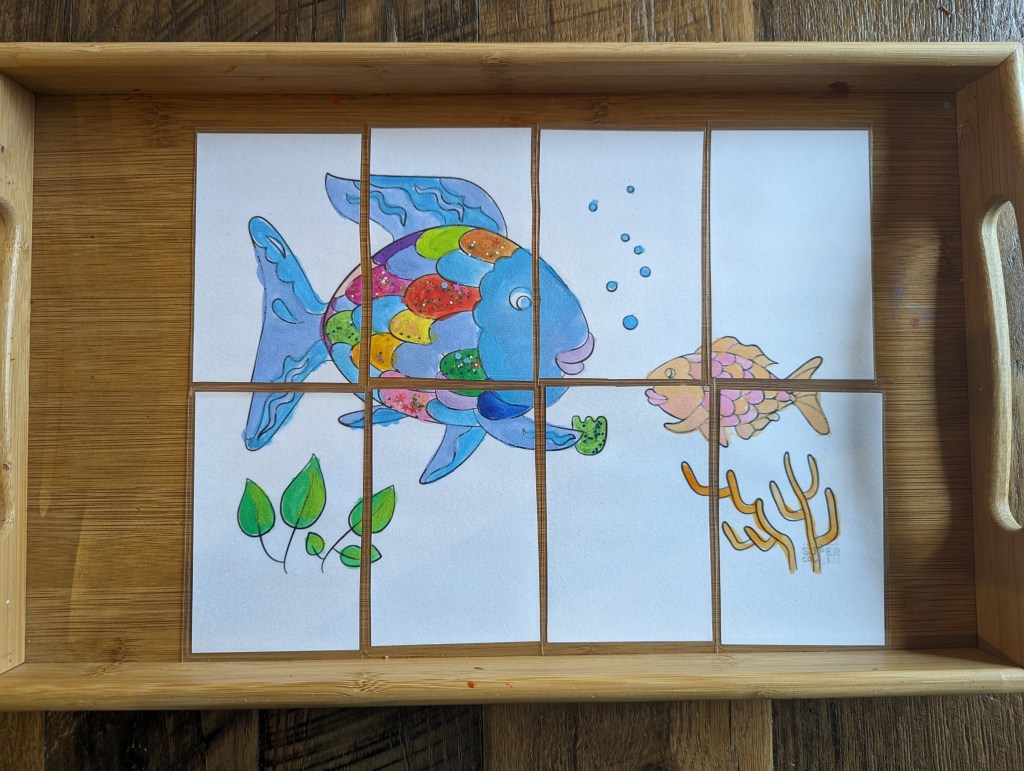
Rainbow Fish 8-Piece Puzzle
This puzzle features a coloring page found free online, and can be adapted in multiple ways. NOTE: Levels A, B, or C do not necessarily mean “more or less difficult,” depending on your learner’s set of skills and areas for growth. I based them on my own learner, who is advanced in numeracy and reading, but coloring, cutting, and visually arranging things are still emerging for him. Another child or adult may find coloring enjoyable and easy, but may not be able to access the numbers/letters portion of the activity.
3 LEVELS OF ACTIVITY ADAPTATION
Level A (highly directed/supported):
- Adult or older helper colors/paints the coloring page, folds into 8 pieces, cuts out, laminates (if available), and again cuts out the pieces.
- Adult uses a dry erase marker to number pieces of the puzzle from top left to bottom right, either 1-8 or as a grid with rows and columns (e.g. 1a, 1b, 1c, 1d, 2a, 2b, 2c, 2d).
- Adult prints and colors a second copy of the puzzle, folds it into 8ths, and numbers each section to match the puzzle pieces.
- Learner uses the guide and numbers to complete the puzzle.
- The numbers can be erased from the puzzle pieces once the learner has a handle on how the pieces are arranged. The “guide” picture can also be removed.
(NOTE: Yes, this may seem over-the-top in its directness, and perhaps seems like it defeats the purpose of trying to figure out a puzzle on your own! But, some children and adults need very explicit instructions and explanations of how something works, and may need examples of how to problem-solve. The goal is to scaffold their learning, so they can feel more confident in eventually completing a puzzle without additional supports. Also, the numbers may tickle the fancy of number-lovers.)
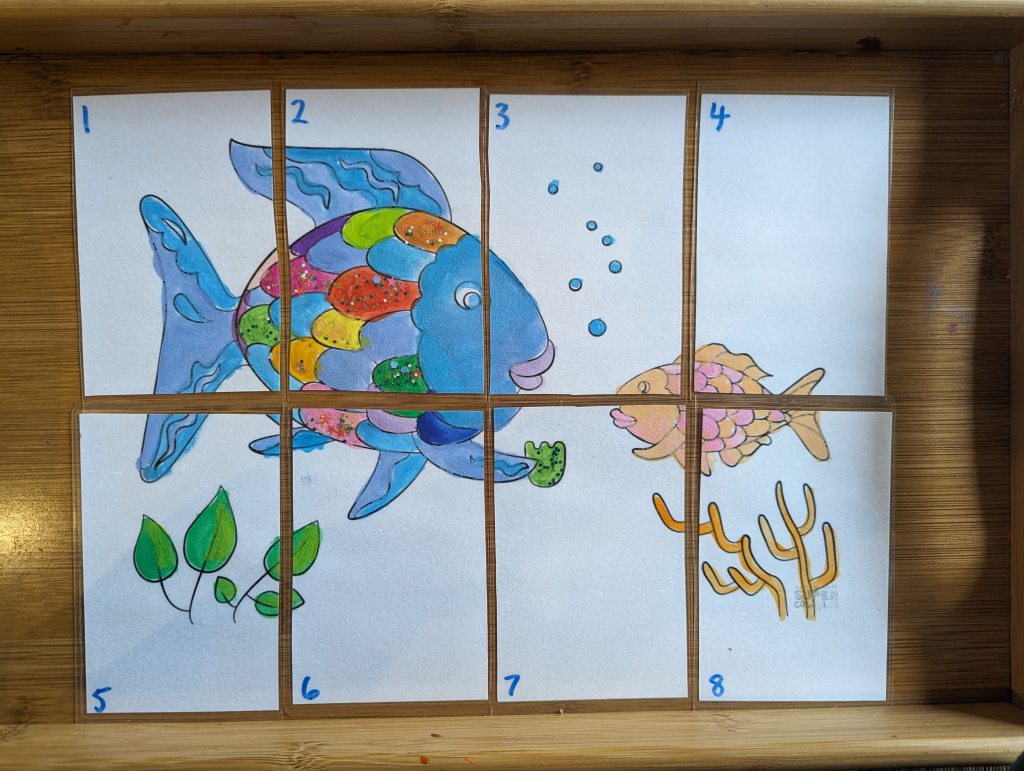
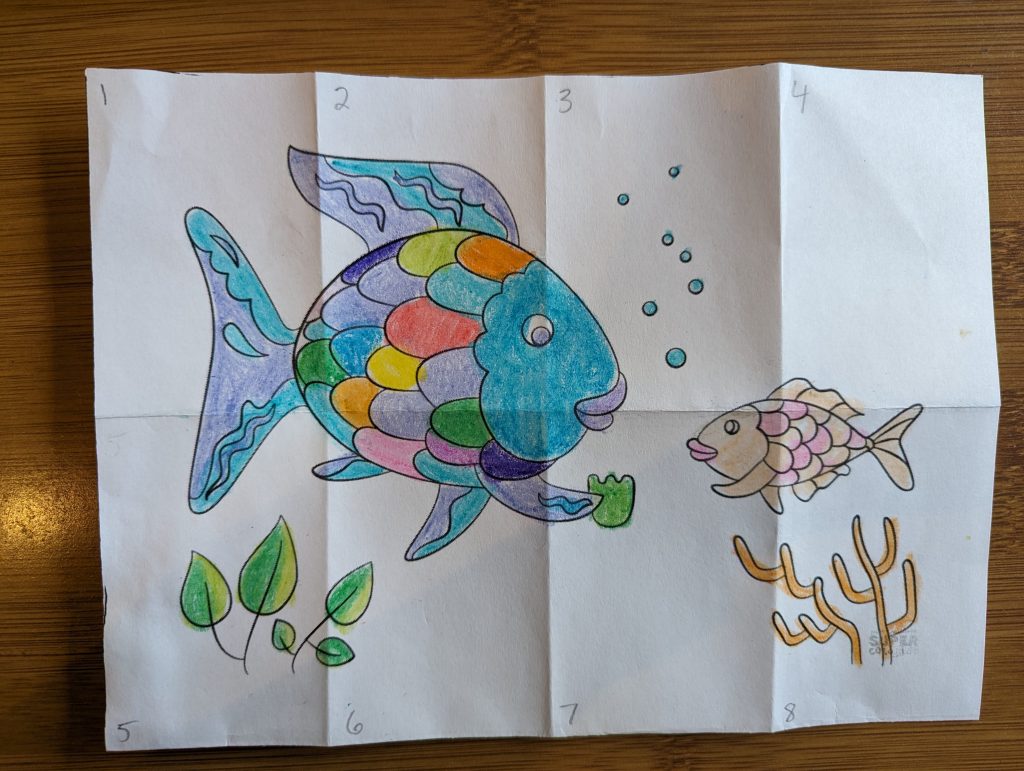
Level B (moderately directed/supported):
- As in Level A, adult prepares the laminated puzzle pieces and the guide picture, but does not number them.
- Learner uses the guide picture to complete the puzzle.
- Guide picture can be removed when learner is confident in completing most of the puzzle independently.
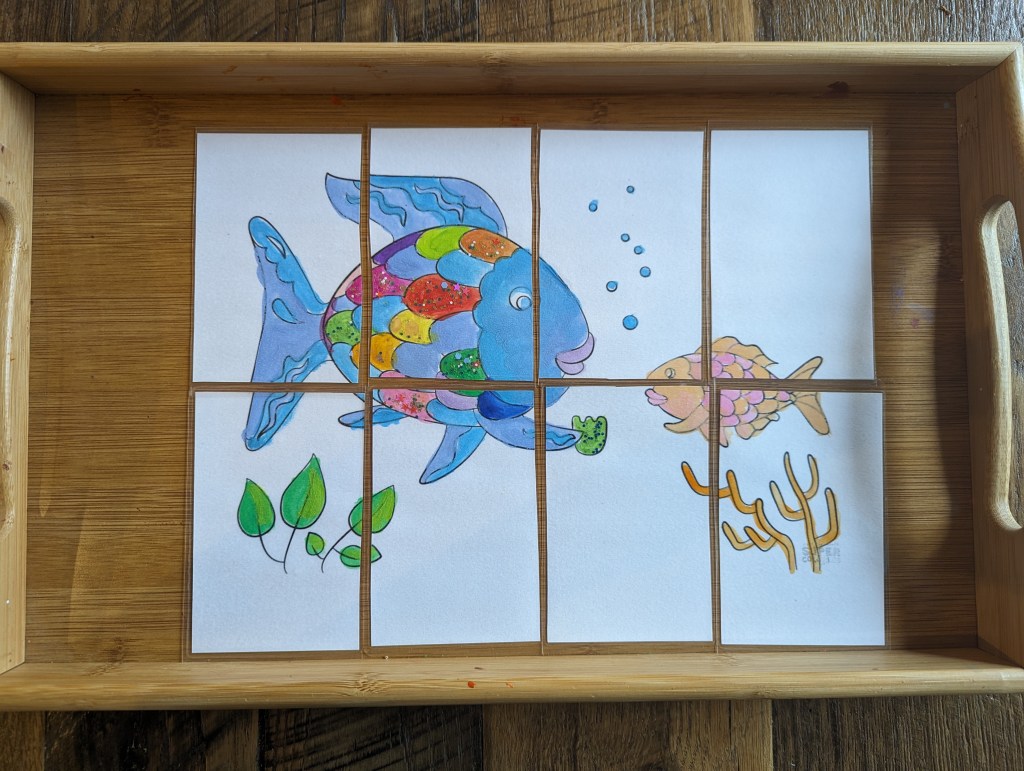
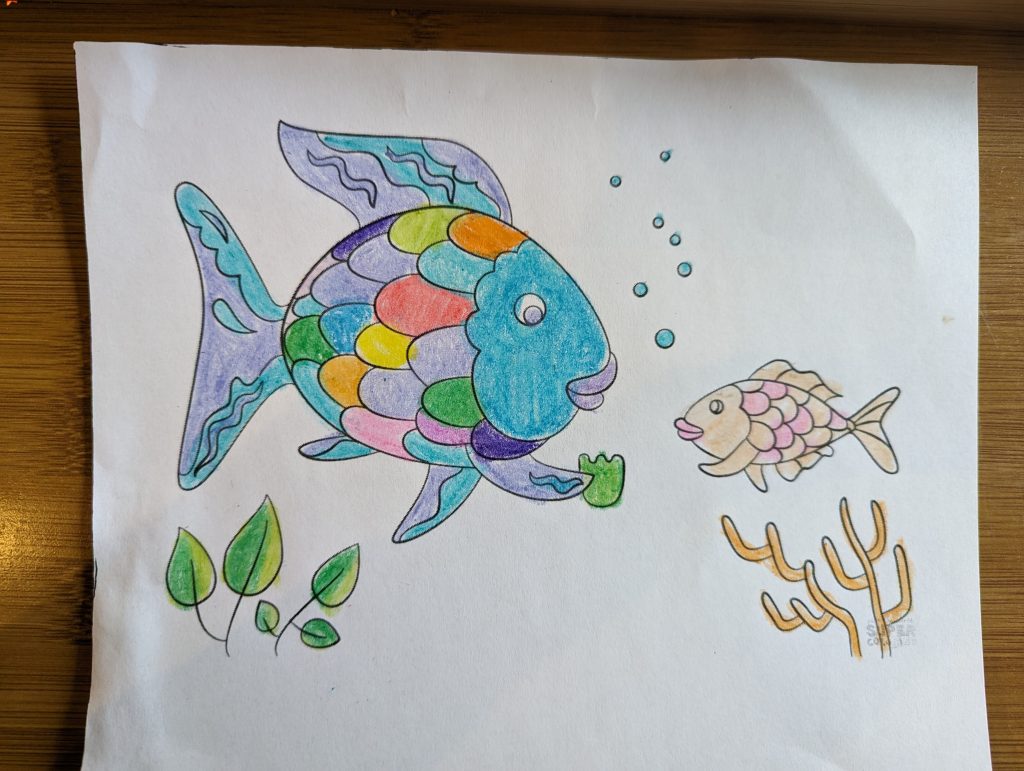
Level C (most open, least supported):
- The learner independently colors the coloring page, and may also fold it into 8 pieces before cutting out each piece with scissors or a paper cutter. (Any step here can be amended!)
- Adult or older helper laminates the pieces, which the learner can also cut.
- Learner completes puzzle independently or with appropriate levels of guidance, if needed.
Rainbow Fish Sparkle Scales Activity
This activity can be adapted for different levels of openness and creativity, as well as fine motor skills.
2 LEVELS OF ACTIVITY ADAPTATION
Level A (highly directed/supported):
- Adult prints Rainbow Fish color by number sheet, leaving it blank.
- Adult creates sparkly, colored scales to match the 5 colors on the sheet (blue, red, pink, green, yellow) using clear packing tape and colored glitter. NOTE: you can make these scales any way you want! I sandwiched glitter between 2 pieces of clear tape, and cut it into scale shapes because it was fun. Not a fan of glitter, or want to make it more recyclable/compostable? Use paper or cardboard wrappers and containers to make colorful, shiny scales.
- Learner places scales onto corresponding number spaces. These can be glued or taped, or they can simply be placed and then reused another time.

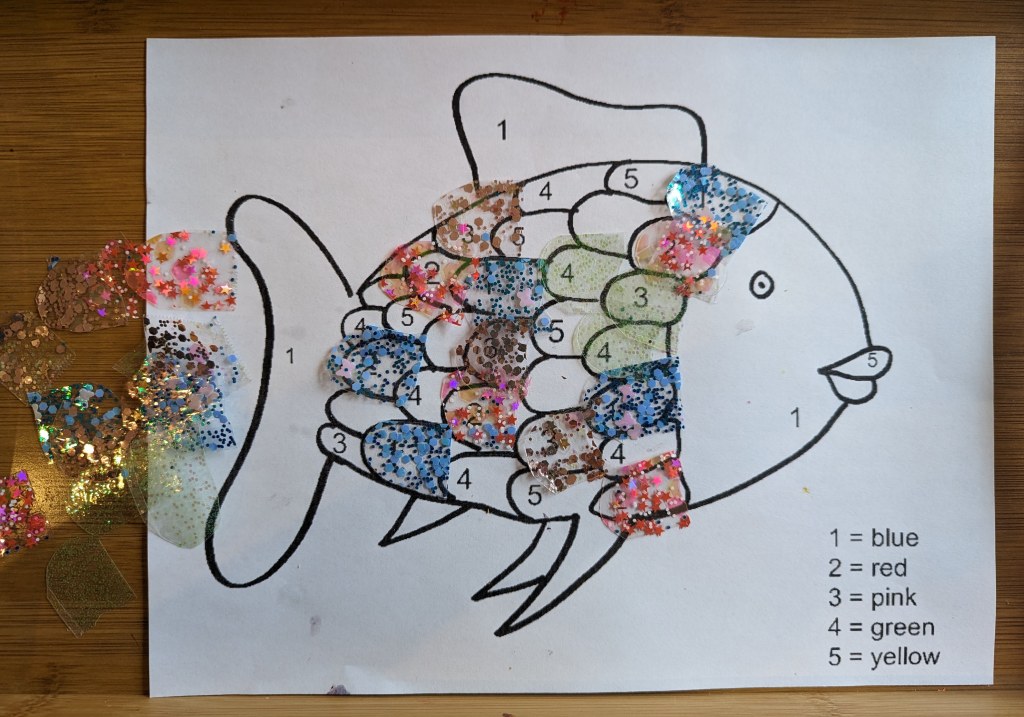
Level B (more open, less directed):
- Adult prints a Rainbow Fish coloring sheet without numbers.
- (Same as Level A step #2).
- Learner can either color the fish with markers, paints, or crayons before placing and gluing the sparkly scales, or they can simply glue the sparkly scales in any arrangement.
 mushrump.com